
The Joy of Greek Weddings
As a band leader, I thought it would be fun to write an article that pertains to the festive and joyful Greek wedding tradition and learn more about it. Greek wedding receptions are high-energy affairs with Greek dancing and American dance music throughout the evening. This article is based on my experience and my research
HERE ARE SOME TIPS for Greek Weddings
The Stefana – The translation is the crowns. The bride and groom wear the crowns during the wedding ceremony. This tradition originated in ancient Greece where the bride and groom would wear olive branches and leaves. It has been adapted to be an integral part of the Greek wedding ceremony.
Greek Pre-Wedding Things to Do
There are certain times of the year that should be avoided if you’re having the wedding ceremony at a Greek Orthodox Church. These include the period between Lent and Easter as well as the period between December 12 and Christmas which is the Nativity Fast.
Some Greek families observe the Virgin Mary’s holiday which is the first two weeks in August. Pentecost is also a day to be avoided for your ceremony.
The Engagement Party
It’s a former Greek tradition that doesn’t happen as often these days, but it’s a great way of honoring the tradition and at the same time having both families get to know one another better.
In this ceremony, the priest blesses the couple and the wedding rings. This also takes place at the beginning of the wedding ceremony, and that’s why many couples don’t have this ritual take place at an engagement party.
What to Wear
There’s nothing different that the bride & groom need to wear. The bride chooses a white dress. The veil is optional. The groom wears a tuxedo of any color he chooses, but black is the standard.
The guests wear what is appropriate and written on the wedding invitations just as they would at any wedding ceremony or wedding reception.
Formal or Black-tie is optional would mean suits or tuxedos and cocktail dresses or long dresses for the females. If black tie preferred is written on the invitations, the men should be in tuxedos and the ladies in long dresses but not necessarily gowns.
The Wedding Entrance
The Greek processional differs from the American tradition. In the Greek tradition, the bride walks with her father and also with other family members to the doors of the church.
The groom is waiting for the bride. When the bride arrives, the groom kisses the bride’s father’s hand, which demonstrates respect for the bride’s father. Then the bride and groom walk down the aisle together followed by the rest of the family.
The Greek Wedding Ceremony
The Greek Orthodox wedding ceremony has some unique traditions. This beautiful ceremony is made up of two segments – the betrothal service and the crowning service. During these segments, there are scripture readings. Every rite that happens is in groups of three representing the Father, Son, and the Holy Spirit.
Usually, personal wedding vows are not included in the Greek wedding ceremony and the kiss is not written into the ceremony, but usually, this universal tradition takes place at the end of the ceremony.
The Sponsor of the Bride and Groom
Every important component of the Greek ceremony and reception is the Koumbaro and Koumbara because they are the sponsors. They stand at the altar with the bride and groom and perform certain functions during the ceremony. The Koumbaro and Koumbara are usually the Godparents but they can also be the siblings or best friends of the bride and groom.
The Lambades and the Wedding Table
An important part of the ceremony is the lighting of the candles or Lambades – one for the bride and one for the groom. The Koumbaro or Kuombara is responsible for obtaining the Lambades. They are also responsible for providing the wedding table and a tray where the priests place the Lambades and other religious items.
The Wedding Crowns
Another important tradition is the exchanging of crowns or Stefanas. The crowns are usually gold or silver and are connected by a white ribbon. The priest blesses the Stefanas and places them on the heads of the couple. After the priest, the Koumbaro or Koumbara then exchanges the crowns three times
The Common Cup
The bride and groom take three sips from the cup, which symbolizes their mutual sharing of life’s joys and sorrows. The common cup is filled with blessed wine similar to communion but unlike the Catholic tradition only the bride and groom participate in this tradition.
The Dance of Isaiah
After drinking from the common cup, the priest leads the couple around the marriage table three times. This tradition symbolizes the couples’ first steps together as husband and wife. It’s customary that at his point, the mothers of the bride and groom throw flower petals at their children.
The Receiving Line
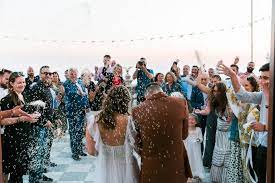
When the ceremony concludes, the bride and groom, their families with the koumbara and Koumbaro line up at the back of the church and the guests will meet them as they leave the church. Traditionally, the guests throw rice at the couple. The rice is a symbol of prosperity and fertility.
The Reception
Greek dancing is a very important part of a Greek wedding reception. The Greek dancing can be at any time of the reception, but many times it happens at the very beginning of the reception.
The bride and groom lead it off followed by the parents, the Koumbara and Koumbara, and then the guests. These dances are usually the Syrto which is a very popular Greek style dance set to many Greek dance songs.
Throughout the reception, there are a variety of traditional and modern Greek dance songs are played. It’s great energy and so much fun!
The Money Dance
This tradition is often done when friends and family throw dollar bills at the couple as they dance. It usually takes place at a specific time. The couple should coordinate the time with the band leader or the D.J.
Greek Traditional Food
A very important part of a Greek wedding is Koufeta. They are sugar-coated almonds that symbolize the sweetness of life that the bride and groom will experience in life.
These almonds are wrapped in groups of five. This number of almonds can’t be divided evenly, just as a couple shouldn’t be divided. The number of five almonds also symbolizes the five wishes of happiness, health, family, wealth, and long life as husband and wife.
All brides and grooms want the same thing for their wedding reception – a great band, a packed dance floor, and favorable comments from their guests expressing how much fun they had. Adding the element of cultural tradition creates a warmth and intimacy that only adds to the success of your special day.
The Sid Miller Dance Band has performed for many Greek wedding receptions throughout the years. The band can provide Greek recorded music during the Greek dance portions of the evening or work seamlessly with a D.J. playing Greek dance music so you have the best in American and Greek dance music.
Image from wedding wire article 7 Greek Wedding Traditions & the Meanings Behind Them
If you have any questions, call Sid at 267-259-7570. We would love to hear from you.
To learn more about The Sid Miller Dance Band click here.